
Rideshare Accident Attorneys Keep This Insurance Secret (Here’s the Truth)

This revealing blog post exposes the complex insurance challenges rideshare accident victims face, including three-phase coverage systems, documentation requirements, and extended settlement timelines. It explains why standard legal advice falls short in rideshare cases and provides actionable insights for protecting your rights after an Uber or Lyft accident.
Kansas City Car Accident Checklist 2026: The 7 Steps That Protect Your Settlement
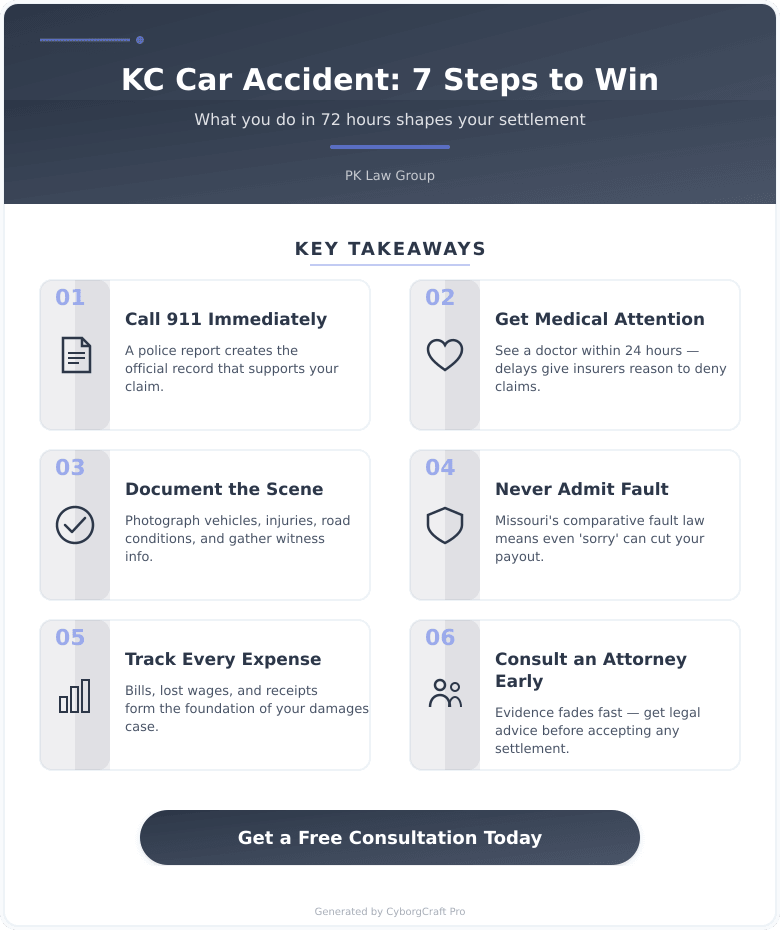
After a car accident in Kansas City, Missouri, the decisions you make in the first 72 hours can define your entire settlement outcome. This post walks through a practical 7-step checklist covering everything from calling 911 and getting prompt medical attention to avoiding recorded statements and tracking every expense. It explains Missouri’s pure comparative fault system, the state’s 5-year statute of limitations, and how minimum insurance requirements compare to neighboring Kansas. A detailed comparison table breaks down coverage types across both states, which matters for drivers near the State Line Road corridor. The post also covers the four most common mistakes that derail Kansas City car accident claims – including social media activity and accepting early settlement offers – and explains when self-representation works versus when an attorney changes the outcome. Key takeaways reinforce that contingency fee representation costs nothing upfront and that settling before maximum medical improvement can leave real money behind. The FAQ section addresses costs, timelines, uninsured driver scenarios, and partial fault rules under Missouri law. PK Law Group serves clients throughout the KC metro including Blue Springs, Grandview, and Olathe, handling car accidents, truck accidents, and premises liability matters on a contingency fee basis.
You Were Hurt in an Uber in Kansas City – Here’s Who Actually Pays in 2026
Getting hurt in an Uber in Kansas City raises one question above all others: who actually pays? The answer depends almost entirely on what the driver was doing at the moment of the crash. Uber structures coverage in three phases tied to the driver’s app status. When the app is off, only the driver’s personal policy applies and Uber provides nothing. When the driver is logged in but waiting, Uber offers contingent coverage up to $50,000 per person. When a ride is active – meaning you’re in the car – Uber’s $1 million commercial policy kicks in, along with uninsured motorist coverage for crashes caused by uninsured drivers. Missouri follows fault-based liability rules and gives injured passengers a five-year statute of limitations, but waiting erodes evidence fast. The post walks through the exact steps to take after a Kansas City Uber crash, including screenshotting your trip record, calling 911, seeking immediate medical care, and contacting an attorney before speaking to any insurance adjuster. A comparison table breaks down each coverage phase clearly. A document checklist covers everything injured passengers need to gather before filing. The FAQ section addresses common questions about suing Uber directly, dealing with uninsured drivers, pedestrian claims, and what rideshare claims are typically worth under Missouri law. PK Law Group in Kansas City handles these claims on a contingency fee basis with no upfront cost to clients.
18-Wheeler vs. Passenger Car in Kansas City: Why Truck Accident Cases Are Different and Worth More
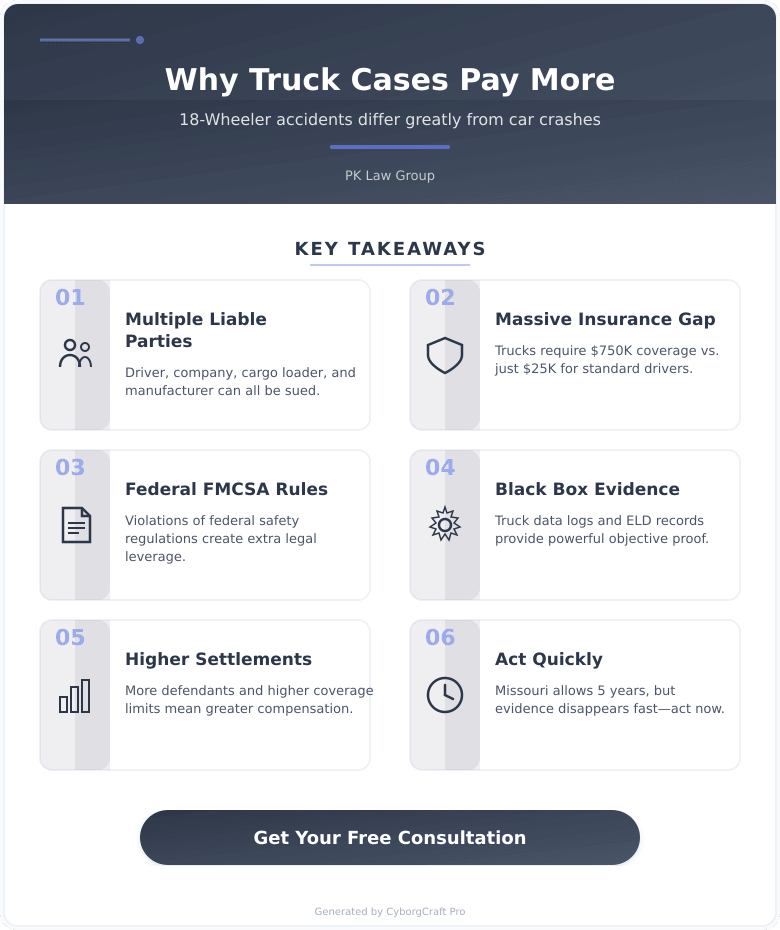
Truck accident cases in Kansas City carry significantly more legal weight than standard car crash claims-and most injured people do not realize how different they are until they have already made costly mistakes. Commercial 18-wheelers operate under federal FMCSA regulations that create multiple layers of liability beyond what exists in a typical passenger car collision. The trucking company, cargo loader, maintenance contractor, and driver may all share fault, and federal insurance minimums start at $750,000 compared to Missouri’s $25,000 floor for personal vehicles. Evidence like black box data and electronic driver logs can disappear within 30 days if a legal preservation letter is not sent quickly. The post outlines the core legal differences between truck and car accident claims, a step-by-step action plan for injured victims, common mistakes that reduce settlement value, and a checklist of documents to gather before a consultation. A direct comparison table breaks down liability, insurance, evidence, and average settlement ranges side by side. Key 2026 deadlines are addressed, including the proposed reduction to Missouri’s personal injury statute of limitations. PK Law Group handles these cases on a contingency fee basis, serving Kansas City and surrounding communities in Missouri and Kansas, with no fees owed unless compensation is recovered.
Missouri Is Cutting Your Lawsuit Window from 5 Years to 2 – What Kansas City Injury Victims Must Do Right Now
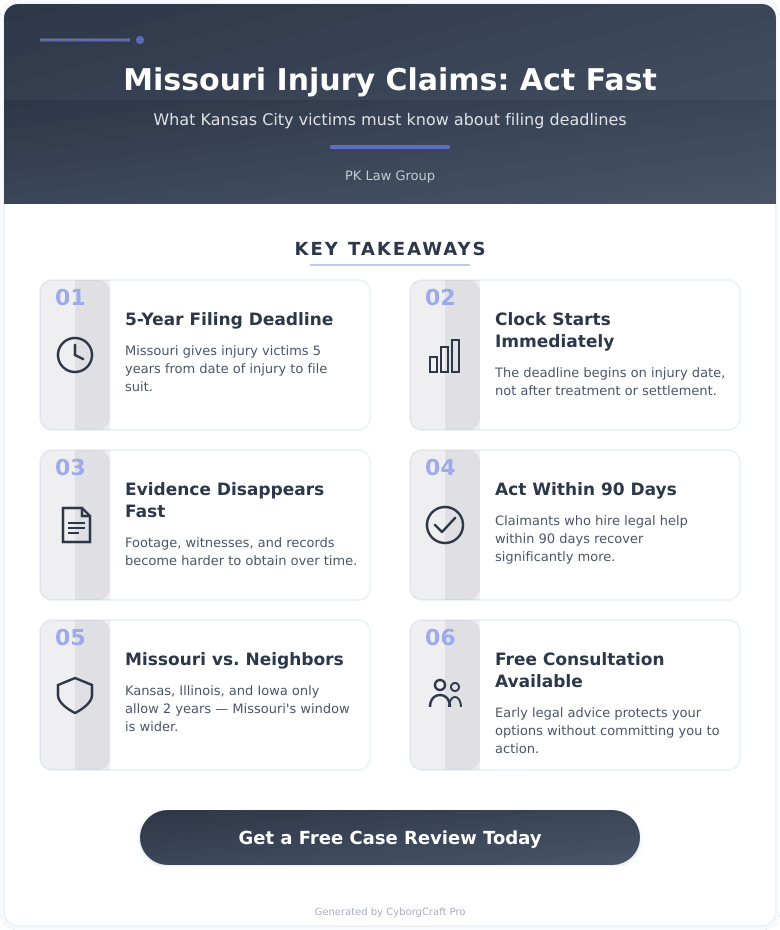
Missouri’s 2026 legislative change slashed the personal injury statute of limitations from five years to just two years, creating an urgent deadline for Kansas City injury victims. The post explains exactly what changed, why it matters, and what steps injured people must take immediately to protect their right to recover compensation. A state comparison table shows how Missouri’s new two-year deadline aligns with Kansas and Illinois but is stricter than Arkansas and Nebraska. A five-step action plan walks readers through documenting evidence, getting consistent medical care, avoiding recorded insurance statements, and consulting an attorney before the critical 90-day mark. The post covers the most common mistakes that destroy injury claims, including accepting quick settlements and posting on social media. Missouri’s pure comparative fault rule is explained, confirming victims can still recover even with partial fault. A preparation checklist helps readers gather the right documents before their free consultation. PK Law Group operates on a contingency fee basis, meaning no fees unless they recover compensation, and serves clients throughout the Kansas City metro area including Grandview, Blue Springs, and Olathe within a 50-mile radius.
Slipped at a Kansas City Store in 2026? Here’s the Evidence You Need Before You Leave
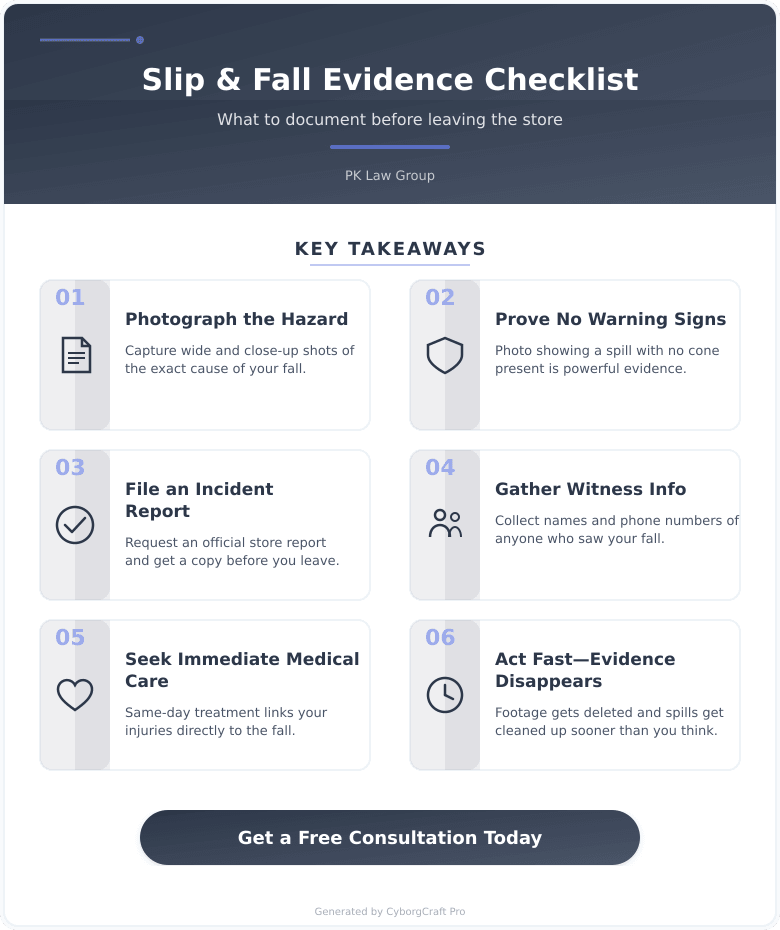
Slip and fall claims in Kansas City live or die on the evidence collected at the scene. Surveillance footage disappears within 24 to 72 hours at most retail locations, hazards get cleaned up, and witnesses leave. This post walks Kansas City injury victims through a seven-step evidence action plan: photographing the hazard immediately, documenting the absence of warning signs, requesting an official incident report, collecting witness contact information, photographing visible injuries, seeking same-day medical attention, and preserving clothing and footwear. A comparison table shows why documenting at the scene is far superior to waiting. The post covers Missouri premises liability law, the state’s five-year statute of limitations, and how the pure comparative fault system affects compensation. Common mistakes that hurt claims are listed clearly, including apologizing to staff, skipping medical treatment, and posting on social media. A concise FAQ section answers questions about timelines, what to do without photos, contingency fees, and case duration. PK Law Group serves injury victims across the Kansas City metro, including Grandview, Blue Springs, Olathe, and surrounding communities, working on a contingency fee basis with no upfront cost to clients.
Missouri Wrongful Death Claims 2026: What Families in Kansas City Need to Know About the 3-Year Deadline
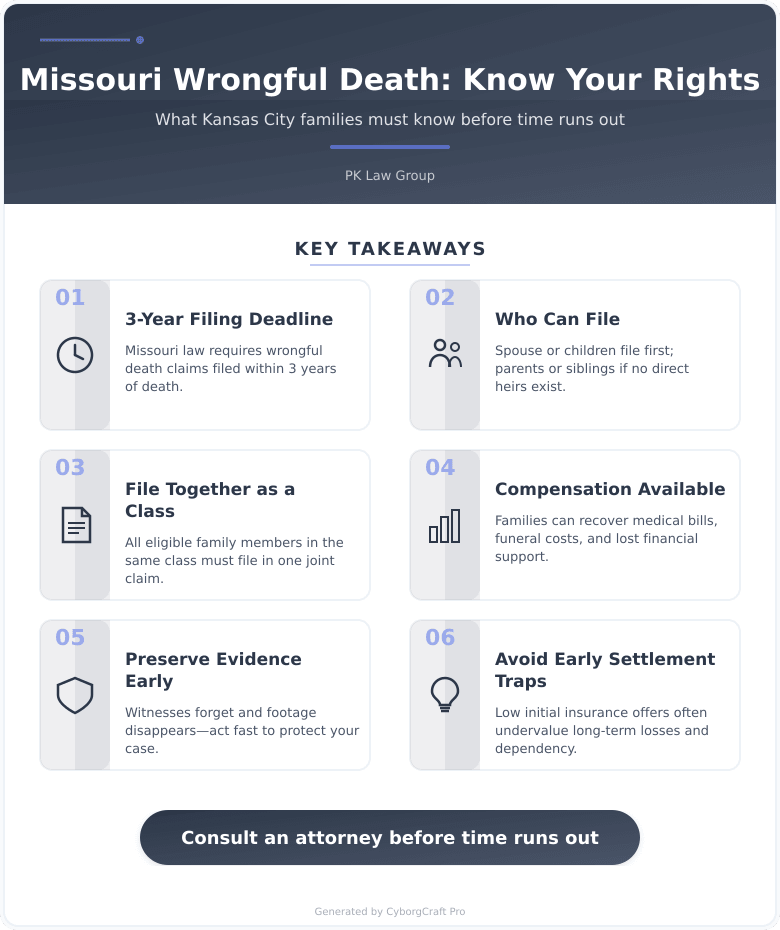
Missouri wrongful death claims carry a strict three-year statute of limitations under Missouri Revised Statutes Section 537.080. Missing this deadline permanently eliminates a family’s right to seek compensation, regardless of how strong their case may be. The post covers who qualifies to file under Missouri law – starting with spouses and children – and explains the state’s unique class filing rule requiring all eligible family members to join the lawsuit together. Families learn what economic and non-economic damages are recoverable, why Missouri’s framework is actually more generous than Kansas and Illinois, and why settling too quickly can leave significant money on the table. A practical five-step action plan walks families through evidence preservation, identifying eligible filers, avoiding common insurer tactics, and meeting the filing deadline. The post includes a document checklist for the first consultation, the most common mistakes that weaken Missouri wrongful death cases, and answers to six frequently asked questions covering costs, eligibility, criminal vs. civil proceedings, and whether an attorney is necessary. PK Law Group in Kansas City handles these cases on a contingency fee basis with no upfront cost to families. The post serves families throughout the Kansas City metro including Blue Springs, Grandview, and Olathe.
Why Kansas City Insurance Adjusters Offer Low Settlements Immediately After a Crash (And How to Push Back)
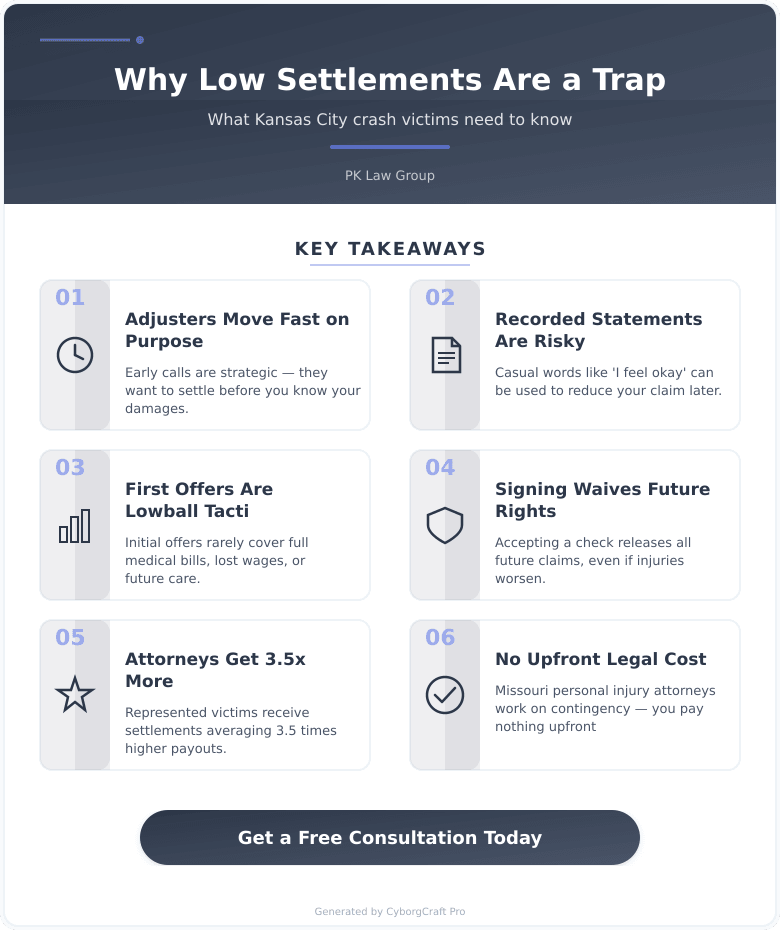
Insurance adjusters in Kansas City contact crash victims quickly and offer low settlements as a deliberate tactic to close claims before injured people understand the full scope of their losses. This post breaks down the specific reasons adjusters move fast, the most common pressure tactics they use – including recorded statement traps, friendly lowball offers, and delay strategies – and why accepting the first offer almost always benefits the carrier, not the victim. A direct comparison shows that represented injury victims recover significantly more on average than those who settle alone. The post includes a step-by-step push-back action plan, a document checklist for consultations, and Missouri-specific information about the five-year statute of limitations for personal injury claims. Key takeaways remind Kansas City readers that early offers are strategic, not generous, that recorded statements should be avoided, and that contingency-fee representation costs nothing upfront. PK Law Group serves injury victims throughout the Kansas City metro area, including Grandview, Blue Springs, Olathe, and surrounding communities within 50 miles.
Kansas City Misdiagnosis Cases: What You Need to Prove to Win a Medical Malpractice Claim
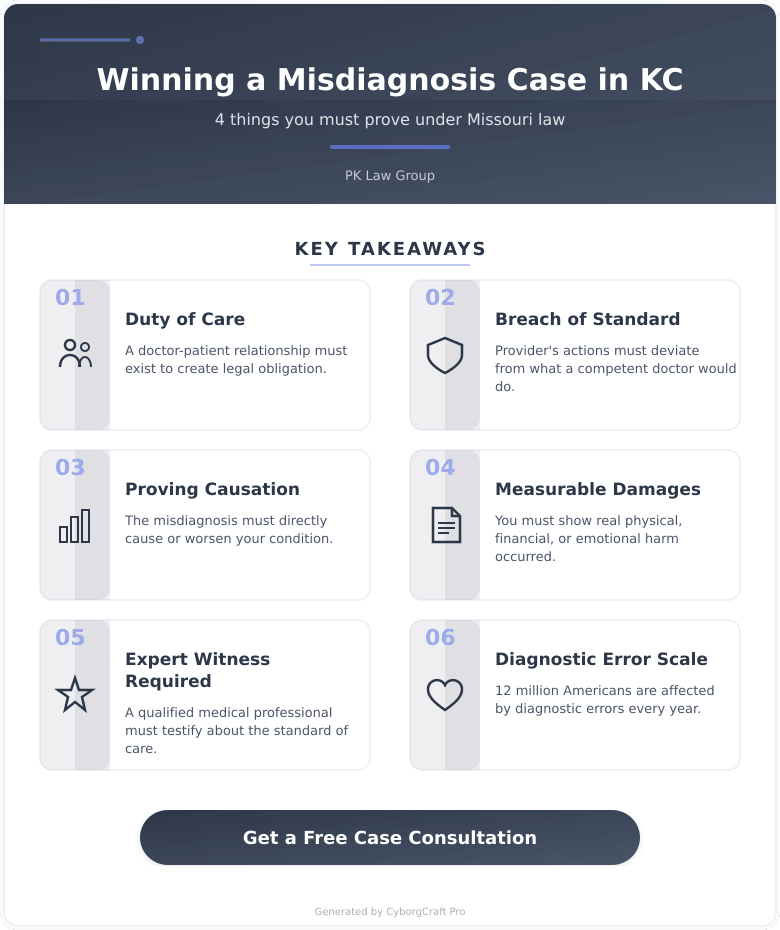
Winning a medical malpractice misdiagnosis claim in Kansas City requires satisfying four specific legal elements under Missouri law: establishing a duty of care, proving the provider breached the accepted standard of care, demonstrating that breach directly caused harm, and showing measurable damages. Causation is often the hardest element to prove, particularly in delayed diagnosis situations where Missouri courts apply a ‘loss of chance’ theory. The post explains the difference between misdiagnosis and delayed diagnosis claims, compares how each plays out in court, and outlines Missouri’s two-year statute of limitations that governs these cases as of 2026. A five-step action plan helps injury victims understand what to gather and when to act. Key conditions commonly involved in these claims include cancer, missed cardiac events, and undiagnosed infections. The content also addresses what ‘standard of care’ means in practice, why professional testimony is nearly always required, and how PK Law Group’s contingency fee model works for Kansas City residents pursuing these cases throughout Jackson, Johnson, Clay, and surrounding counties.
Kansas City Motorcycle Accident Claims 2026: What Bias Against Riders Looks Like in Negotiations
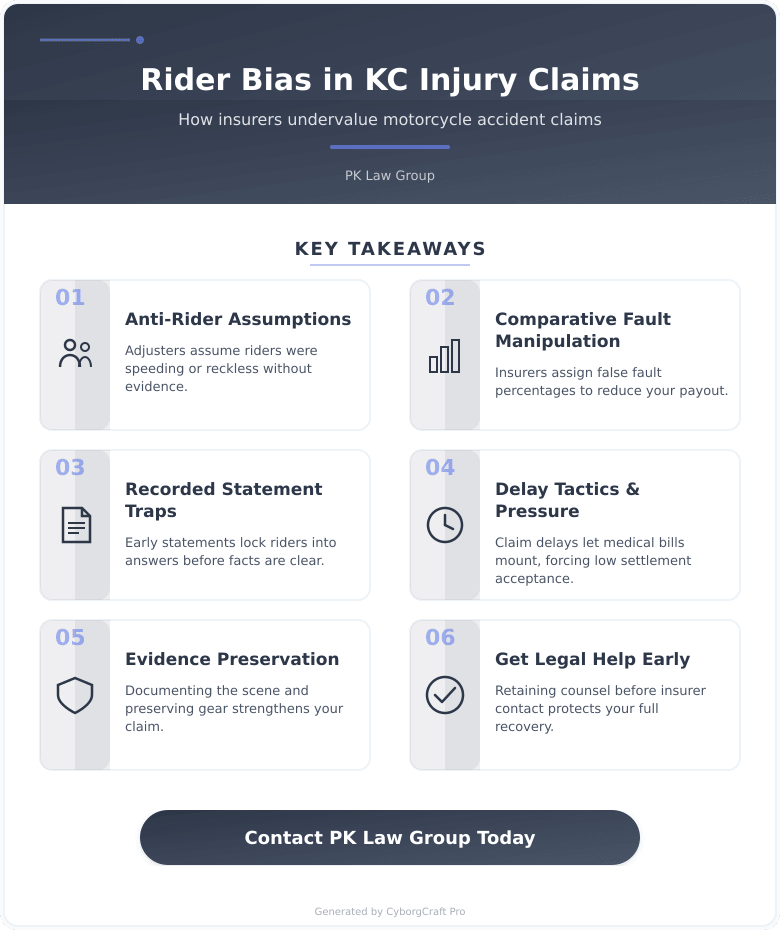
Motorcycle accident claims in Kansas City face a specific challenge that most car accident cases do not: systematic rider bias in insurance negotiations. Adjusters routinely assign unsupported comparative fault to riders, question gear choices, and use recorded statements to lock injured motorcyclists into positions that reduce their settlement value. Under Missouri’s pure comparative fault rule, every percentage of fault attributed to a rider directly cuts their compensation – making these tactics financially significant. The post breaks down exactly how bias shows up in practice, from early lowball offers to character-based scrutiny of riding behavior, and provides a six-step action plan riders can follow immediately after a crash. A comparison table outlines how motorcycle claims differ from car accident claims across key negotiation dynamics, and a damage category table shows where bias hits hardest – specifically in pain and suffering valuations. Key legal context includes Missouri’s current five-year statute of limitations and proposed 2026 legislation that could shorten that window. PK Law Group handles these cases on a contingency fee basis, serving riders throughout Kansas City, Missouri and the metro area including Grandview, Blue Springs, and Olathe.